
Choosing Your Wellbeing Path: Coaching vs. Therapy
Updated: Oct 25

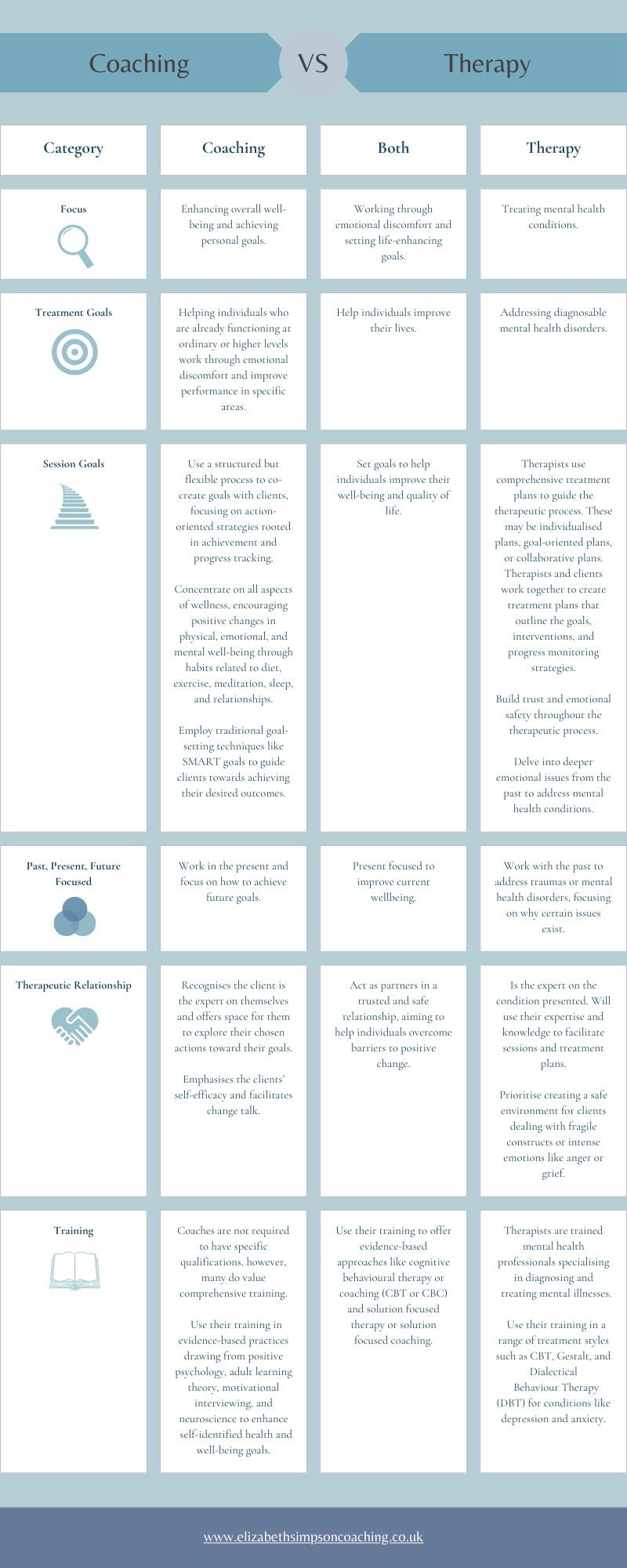
AT A GLANCE: Coaching vs Therapy: What Is the Difference and How Do You Choose?
|
IN THIS ARTICLE
What Is the Difference Between Coaching and Therapy?
When Is Therapy the Right Choice?
When Is Coaching the Right Choice?
Can You Have Coaching and Therapy at the Same Time?
How Do You Choose the Right Coach or Therapist?
What Can Wellbeing Coaching Offer You?
Coaching and therapy are both forms of professional support, but they work differently, serve different needs, and are not interchangeable. Therapy addresses mental health conditions and is delivered by regulated practitioners. Coaching works in the present, focuses on goals and wellbeing, and operates outside the mental health regulation framework. The confusion between them is understandable: both involve a one-to-one relationship, both deal with how a person thinks and feels, and some practitioners hold qualifications in both. What they are not is the same thing. Knowing the difference makes it easier to decide which one is the right fit, and whether one, the other, or both might be useful at this point in your life.
What Is the Difference Between Coaching and Therapy?
The most practical way to understand the difference is through what each one is designed to do.
Therapy, including counselling, psychotherapy, and clinical psychology, is designed to assess and treat mental health conditions. Therapists are trained mental health professionals. In the UK, psychologists are regulated by the Health and Care Professions Council (HCPC). Counsellors and psychotherapists are not legally regulated in the same way, but the major professional bodies, the British Association for Counselling and Psychotherapy (BACP) and the UK Council for Psychotherapy (UKCP), set ethical standards, training requirements, and codes of practice. Most reputable therapists will be registered with one of these bodies.
Coaching is not a regulated profession in the UK. There is no legal requirement to hold any qualification to call yourself a coach. Accreditation through bodies such as the Association for Coaching (AC) or the International Coaching Federation (ICF) is voluntary: it sets standards for training, supervision, and ethical practice, but it is not enforced by law. This means the quality and approach of coaches varies considerably, which is why checking for professional accreditation matters when choosing one.
In terms of approach, therapy often works with the past to understand present difficulties. Coaching works in the present and focuses on goals, direction, and wellbeing. Therapy treats; coaching develops. There is some overlap: both involve a trusted one-to-one relationship, both can work with emotional discomfort, and both can support goal-setting. The clinical remit, regulatory framework, and training are different.
When Is Therapy the Right Choice?
Therapy is the right choice when mental health is the primary concern. This includes diagnosed conditions such as depression, anxiety disorders, PTSD, OCD, and eating disorders, as well as situations where past experiences are significantly affecting how someone functions day to day.
A useful working guide: if the question is “why do I keep responding this way?” or “what is happening to me?”, and the answer may involve trauma, a clinical condition, or patterns rooted in earlier experience, therapy is likely the more appropriate route.
In the UK, therapy is available through the NHS via a GP referral, or privately through practitioners registered with the BACP, UKCP, or HCPC. The BACP Therapist Directory at bacp.co.uk is a reliable place to search for accredited practitioners.
Coaching is not a substitute for therapy, and a good coach will be clear about this. If a client’s needs go beyond the scope of coaching, a responsible coach will say so and, where appropriate, suggest they speak to their GP or a qualified therapist.
When Is Coaching the Right Choice?
Coaching works well when someone is already functioning and wants to move forward in a specific area of life. That might mean improving wellbeing, building healthier habits, working through a period of uncertainty, or making progress on goals that keep getting deprioritised.
The coaching client does not need to be in crisis. Often it is someone who has the insight and the intention to change something, and finds that knowing what to do and actually doing it are two different things. That gap between intention and action is exactly where coaching is most useful. (See: Wellbeing Barriers: Why the Gap Between Knowing What You Need and Actually Doing It Is Not a Motivation Problem)
Wellbeing coaching focuses on psychological, physical, and emotional wellbeing. It draws on evidence-based psychology to support women who want to improve how they feel and function, without requiring a significant overhaul of everything they are already doing. It does not diagnose, and it does not treat mental health conditions.
If you want a low-commitment starting point, the Pause Practice is a free, ten-minute guided wellbeing experience that can help you get clearer on what is actually getting in the way and where a realistic starting point might be. Start the Pause Practice, it’s free →
Can You Have Coaching and Therapy at the Same Time?
Yes. Coaching and therapy serve different roles, and for some people they work well alongside each other.
A therapist might be working with someone on a specific mental health condition: processing past experiences, managing symptoms, working through a diagnosis. A coach working alongside them is focused on the present and the future: goals, habits, wellbeing, and how to take realistic steps forward while managing those other challenges.
The two do not overlap in terms of clinical remit. A coach is not doing therapeutic work, and a therapist is not doing coaching. When both practitioners are aware the client is working with the other, they can each operate in their respective areas without conflict.
If you are currently in therapy and wondering whether coaching might add something, the best starting point is to raise it with your therapist. They will know your situation and can advise on whether the timing is right.
How Do You Choose the Right Coach or Therapist?
For a therapist
Look for registration with the BACP, UKCP, or HCPC. These registers are searchable online. Check that the therapist’s specialism matches your needs; many focus on specific approaches such as CBT, person-centred therapy, or EMDR, or work with particular populations. Most offer an initial consultation, which is a good opportunity to ask how they work and what to expect.
For a coach
Look for membership with the Association for Coaching (AC) or the ICF, and check what level of accreditation they hold; some levels require a minimum number of supervised coaching hours and ongoing professional development. Ask about their training, their approach to sessions, and whether they have experience in the area you want to work on.
For both
A good practitioner will be willing to explain what they do, how they work, and what you can expect. If something does not feel like a good fit after an initial conversation, it is entirely reasonable to try someone else.

What Can Wellbeing Coaching Offer You?
Elizabeth Simpson is an Accredited Wellness and Resilience Coach, an Accredited Member of the Association for Coaching, and holds an MSc in the psychology of mental health and wellbeing.
Her approach to wellbeing coaching focuses on psychological, physical, and emotional wellbeing, drawing on evidence-based psychology to support women who want to improve how they feel and function, in a way that fits around the life they are already living.
For women who prefer to explore at their own pace before committing to one-to-one sessions, the Women’s Wellbeing Lab offers self-paced coaching tools, guided video sessions, and a psychology-informed resource library, available on your own schedule, with no programme to complete and no fixed pace to keep. The Pause Practice is also available free, as a ten-minute starting point, if you want to try something today before deciding anything else.
(See also: Why Chronic Stress Stops Women Moving Forward | Burnout in Women: Signs, Causes and What Actually Helps)
Explore This in the Women's Wellbeing LabThe Women’s Wellbeing Lab is where you can take the next step, with tools and support that fit around your life.You do not need to be in crisis to deserve support. Wanting to improve your wellbeing is enough of a reason to start. |
FAQ: Coaching vs Therapy
Is coaching the same as counselling?
No. Counselling is a form of therapy delivered by a trained and (usually) accredited mental health practitioner, often registered with the BACP. Coaching is not a regulated profession in the UK and does not address mental health conditions. The two have different training frameworks, different ethical codes, and different clinical remits.
What is the difference between a life coach and a therapist?
A therapist is trained to assess and treat mental health conditions and is typically registered with a professional body such as the BACP, UKCP, or HCPC. A life coach focuses on goals, direction, and personal development. In the UK, life coaching is unregulated; anyone can use the title regardless of training. Looking for professional accreditation through the AC or ICF is the most reliable way to assess quality.
Can coaching help with anxiety?
Coaching can support someone who experiences anxiety as part of everyday life and wants to build wellbeing, develop coping strategies, and improve how they function. It is not a treatment for an anxiety disorder. If anxiety is significantly affecting daily life, a GP or therapist registered with the BACP or HCPC is the appropriate first step.
Is coaching regulated in the UK?
No. Coaching is not a regulated profession in the UK. There is no legal requirement to hold any qualification to practise as a coach. Voluntary accreditation through bodies such as the Association for Coaching (AC) or the International Coaching Federation (ICF) sets standards for training and ethics, but it is not a legal requirement. This is why checking for professional accreditation matters when choosing a coach.
Can I access therapy on the NHS?
Yes, in many cases. NHS therapy is available through a GP referral. The most common route is via IAPT (Improving Access to Psychological Therapies), which offers evidence-based treatments for conditions including depression and anxiety. Waiting times vary by area. Private therapy through a BACP or UKCP registered practitioner is also available without a referral.
How long does coaching take compared to therapy?
Both vary significantly depending on the individual and what they are working on. Coaching is typically focused on the present and future, and some people find value in a relatively short series of sessions. Therapy may involve a longer process, particularly when working with conditions that have developed over time. Neither has a fixed duration; the right length depends on what someone needs and how the work is progressing.
References
British Association for Counselling and Psychotherapy (BACP). What is counselling and psychotherapy? bacp.co.uk
UK Council for Psychotherapy (UKCP). What is psychotherapy? psychotherapy.org.uk
Health and Care Professions Council (HCPC). Register of regulated professionals. hcpc-uk.org
Association for Coaching (AC). What is coaching? associationforcoaching.com
International Coaching Federation (ICF). ICF definition of coaching. coachingfederation.org
About the authorElizabeth Simpson, MSc Psychology, Accredited Wellness and Resilience Coach I'm the founder of the Women's Wellbeing Lab. I hold a master's degree in the psychology of mental health and wellbeing and I'm an Accredited Member of the Association for Coaching. I help women improve their psychological, physical and emotional wellbeing with evidence-based tools that fit around their life. |


Comments